

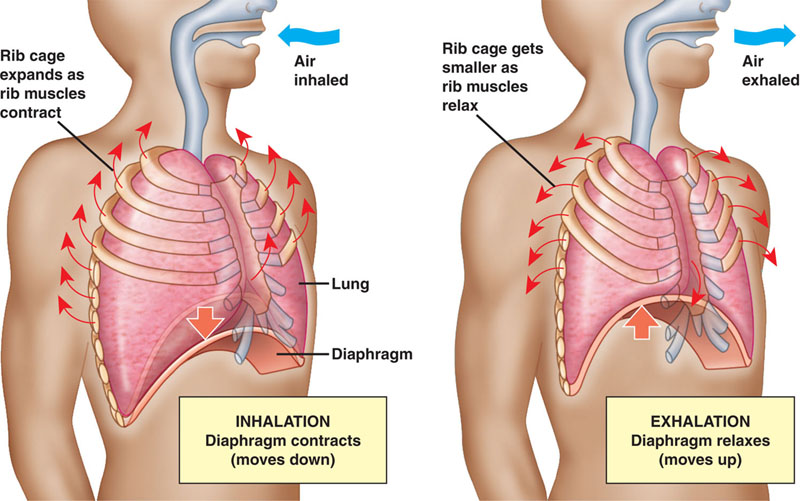
The diaphragm is a muscle that is quite often taken for granted, and overlooked. It works 24-7, 365 days a year for as long as you live. Impressive, right? Every breath we take is given to us by this muscle. The diaphragm connects us with our abdominal wall, pelvic floor and spinal muscles and fascia, becoming a part of the core muscle system that holds our spine and pelvis erect. It is implemental in posture and body mechanics. It is imperative for functions like lifting, running, jumping. This is why proper breathing patterns during exercise are so important.
Diaphragm and Breath
The breath is the key to all we do as humans. The diaphragm is designed to coordinate movement with the pelvic floor, abdominal wall and spine. A study by Hodges et al describes the relationship of the diaphragm with the pelvic floor as a piston like movement. When we inhale, the diaphragm and pelvic floor move down toward our feet and as we exhale, they ascend toward our head. This piston like movement occurs with each breath we take. Not only are the pelvic floor impacted by breathing, but your abdominal wall and deep spinal muscles also engage with the breath (Talasz et al). Connecting with your breath is important for posture and healthy movement.
How Does the Diaphragm Work?
Recent studies have shown that the diaphragm works as a postural muscle in coordination with its traditional role in breathing. In a study by Kolar, MRI demonstrated that the diaphragm functions for posture as well. And this is synchronized with respiration. This coordination allows for intra-abdominal pressure to be maintained sufficiently in conjunction with the abdominal, pelvic floor, and spinal muscles. Dysfunction of this synchronization, or poor and uncoordinated diaphragm activation, leads to overloading of spinal segments, and pain. Diaphragm activation during respiration and postural activities is different in every person. The diaphragm does not participate as one single functional unit in stabilization. Rather, different segments can be activated to different degrees. For example, the diaphragm can still achieve its breathing function from a position that also maintains enough inta-abdominal pressure to provide postural stability for a task.
So what does all this mean, and how can we incorporate this information to best train our bodies and prevent injury?
Diaphragm and the Rest of The Body
First, the function of our bodies is truly an amazing symphony of muscle recruitment timed just right so that we provide just the right amount of movement combined with stability. The Coordination of the diaphragm, pelvic floor, abdominal wall and spinal muscles is activated in anticipation of movement to provide a stable base from which we can move. And we as humans really don’t have to think about it!
Second, this coordinated effort does not function well after surgery, injury or in people who are inactive. There needs to be more attention to incorporating the diaphragm into programs for rehabilitation after surgery or injury, and as well in exercise programs to build strength and to prevent injury.
Proper Breathing and Posture
How can you begin to breathe right and improve posture? Start with a diaphragmatic breath: Inhale, feeling the ribcage expand in a 3 dimensional direction, and the abdomen will rise gently. There should not be any movement of your chest. Practice several repetitions of this, until it feels easy and coordinated. Now, coordinate this with the muscles of the abdomen, spine and pelvis. Inhale, expanding the rib cage and abdomen, Exhale and find a gentle contraction of the pelvic floor (women: like picking up a blueberry with your vagina! Men: get a lift like when you walk into cold water!). As you exhale there should also be a gentle contraction of the abdominal wall and deep spinal muscles. You wont necessarily feel this as a “Strong” contraction, but should see the abdomen flatten gently and the waist get smaller, slightly.
Diaphragm and the Core
As you coordinate these muscles you can begin to bring this coordination of breath and movement to other exercises. Two common programs of exercise that are great for this are yoga and pilates. However, once you coordinate the diaphragm with the “core” just breathing is an activity in core strength.
If you are struggling with back pain, hip pain, or pelvic pain or incontinence, this is implemental in the recovery of this system! Make an appointment to see one of our therapists to help you retrain this system and get back to the things you want to do with less pain and less risk of re-injury! At Foundational Concepts we understand this amazing muscle and how to coordinate it into our programs to help our clients get well. We love educating them about this beautiful relationship and seeing the progress when you give the diaphragm the attention it needs.
–Sarah Dominguez, PT, MSPT, CLT, WCS
References:
1) Akuthota V, Nadler SF. Core strengthening. Arch Phys Med Rehabil 85(3):86-92, 2004
2) Hodges PW, Sapsford R, Pengel LH. Postural and respiratory functions of the pelvic floor muscles. Neurourol Urodyn. 2007;26(3):362-71.
3) Hodges P.W, Butler J.W, McKenzie D.K and Gandieva S.C. Contraction of the human diaphragm during rapid postural adjustments. Journal of Physiology 505, 539-548, 1997
4) Talasz H, Kremser C, Kofler M, Kalchschmid E, Lechleitner M, Rudisch A. Phase-locked parallel movement of diaphragm and pelvic floor during breathing and coughing-a dynamic MRI investigation in healthy females. Int Urogynecol J. 2011;22(1):61-68.
5) Kolar P, Neuwirth J, Sanda J, Suchanek V, Svata Z, Pivec M. Analysis of diaphragm movement during tidal breathing and during its activation while breath holding using MRI synchronized with spirometry. Physiol Res 58:383-392, 2009